
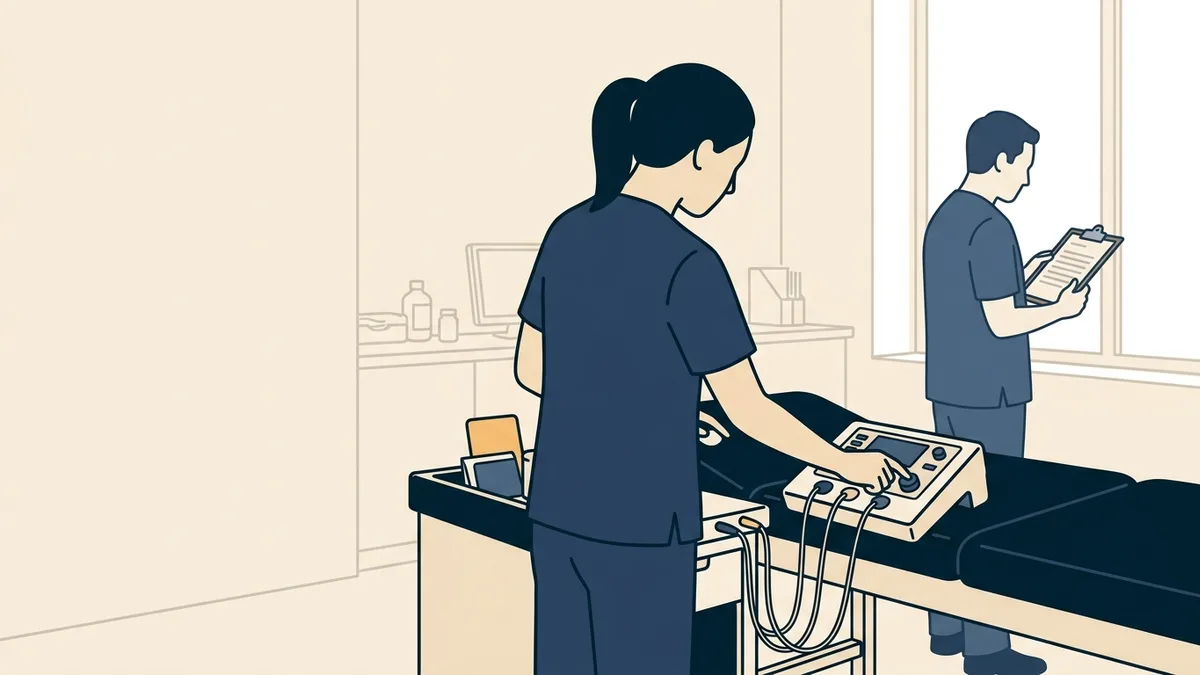
The CCCA is FCLB's national certification for staff who assist with chiropractic therapies. Candidates qualify with 24 approved education hours, 2,000 supervised hours or a member board registration, pass an exam, complete 300 supervised hours in the first year, and renew every two years with 6 CE hours. It is not a state license.
The CCCA, or Certified Chiropractic Clinical Assistant, is a certification program offered by the Federation of Chiropractic Licensing Boards (FCLB) for people who assist with chiropractic therapies in a clinical setting. A candidate qualifies through approved education or supervised experience, passes FCLB's exam, completes 300 hours of supervised clinical experience in the first year, and renews every two years with 6 hours of CE. It is a national credential, not a state license. It matters most where a state board requires it or accepts it, and Alaska is one board that names it in rule.
The details below come from FCLB's chiropractic assistant certification page and CCCA test plan. FCLB's site blocks requests from our research server, so we read archived copies captured by the Internet Archive in 2024 and June 2025. Check FCLB's current page before you pay or schedule anything.
Who is the CCCA for?
FCLB describes the program as designed for individuals who assist with chiropractic therapies in a clinical setting, and says plainly that it is not intended for staff conducting x-rays or front office duties. That distinction matters in practice. An assistant who sets up modalities, applies heat and ice, and takes vitals is the target. An assistant whose main job is radiography needs whatever radiography credential the state requires, which is a different system entirely (see x-ray rules when you move states).
How does a candidate qualify?
Basic eligibility on FCLB's page: at least 18 years old, a high school diploma or equivalent, and good moral character. Then one of these foundations:
- 24 hours of education from a PACE provider (FCLB's Providers of Approved Continuing Education program);
- 24 hours from another provider, subject to FCLB review and a fee;
- 2,000 hours of hands-on experience under the supervision of a licensed chiropractor; or
- a current registration with an FCLB member board.
FCLB does not teach the coursework itself. It publishes a directory of approved CCCA providers and a textbook order form.
What is on the exam?
FCLB's CCCA test plan splits the exam into four domains:
- Foundational knowledge, 30 percent: basic anatomy and physiology, clinical terminology such as flexion versus extension, and common treatment and condition terms.
- Patient safety and procedures, 40 percent: office hazards, therapeutic modality setup, x-ray safety awareness (such as asking about pregnancy), emergency response including CPR, indications and contraindications for common modalities, and vital signs.
- Documentation, 15 percent: intake and consent forms, HIPAA, red flags of fraud, billing and procedure codes, and SOAP-format record keeping.
- Ethics and boundaries, 15 percent: sexual boundaries and harassment, patient and staff relations, finances, confidentiality and confrontational patients.
What happens after the exam?
The candidate earns 300 hours of practical clinical experience under supervision during the first year. Certification then renews every two years with 6 hours of CE. FCLB's June 2025 page listed an initial fee covering the exam, a badge and the first year of registration, and a separate biennial renewal fee; confirm the current amounts with FCLB, since we do not set or collect them.
Which states require it?
FCLB's page said that twelve regulatory boards in the United States have statutory authority over chiropractic assistants. Having authority is not the same as requiring the CCCA, and the boards we have verified handle assistants in different ways:
- Alaska requires clinical assistants to hold FCLB's CCCA, the Tennessee Chiropractic Association's CTA program or a board-recognized equivalent within 12 months of hire, plus current CPR (12 AAC 16.052).
- Arizona runs its own chiropractic assistant registration with 24 hours of board-approved coursework within a year, more if the DC holds physiotherapy or acupuncture certification.
- Nevada certifies chiropractic assistants through its own board exam and fingerprinting.
- Florida registers chiropractic assistants and separately certifies chiropractic physician's assistants, who need a board-approved program of at least 200 didactic classroom hours (section 460.4165, Florida Statutes).
Where a state runs its own registration, the CCCA may help an assistant meet a training requirement, but it does not replace the state filing. Our post on which states regulate chiropractic assistants goes state by state.
Is it worth getting where the state does not require it?
That is an employment decision, not a licensing one. FCLB argues that it standardizes training and may help with insurer credentialing where staff with patient contact must be credentialed. For a multi-state group, a CCCA gives a common baseline across clinics that sit under different state rules, and it is the credential Alaska names if you ever open there. It does not authorize any task a state's law reserves to licensed people, and it does not cover radiography.
How we help
Our Chiropractic Assistant Registration service is $99 per assistant. In a state that registers or certifies assistants, we prepare the state filing and gather the training records, including a CCCA certificate where the state accepts it. In a state that requires a credential within a set time after hire, as Alaska does, we track the deadline. FCLB and board fees are paid to them directly.
Common questions
- Is the CCCA a license?
- No. It is a certification offered by the Federation of Chiropractic Licensing Boards. A state that registers or certifies chiropractic assistants still requires its own filing, though some, such as Alaska, accept the CCCA toward their requirement.
- Does the CCCA let an assistant take x-rays?
- No. FCLB says the program is not intended for staff conducting x-rays. Radiography is governed by each state's radiologic technology law and the chiropractic board's delegation rules.
- Can work experience replace the 24 hours of coursework?
- Yes. FCLB's eligibility options include 2,000 hours of hands-on experience under a licensed chiropractor's supervision, or a current registration with an FCLB member board, in place of 24 hours of approved education.
- Which state requires the CCCA?
- Alaska requires clinical assistants to hold FCLB's CCCA, the Tennessee Chiropractic Association CTA program or a board-recognized equivalent within 12 months of hire, plus current CPR, under 12 AAC 16.052.
Need Help with Your Application?
We handle the chiropractic licensing process end-to-end — eligibility screening, documents, board follow-ups, and tracking.