
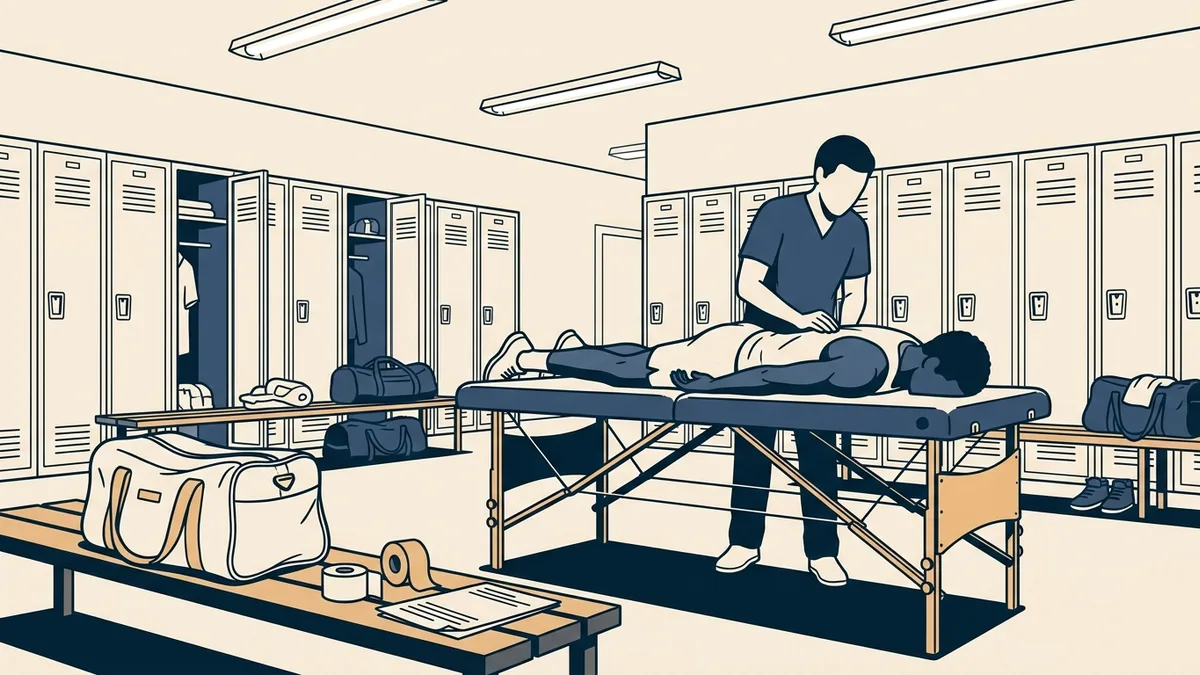
A team chiropractor needs authority in each state where athletes are treated. Nevada exempts team and event DCs for up to 10 days per event, Texas offers a 30-day-a-year temporary license for services not offered to the public, and Alaska a courtesy license per event. The federal Sports Medicine Licensure Clarity Act does not name chiropractic.
A chiropractor who travels with a team needs authority to practice in each state where athletes are treated, just as at home. There is no chiropractic compact. What helps is a handful of state laws written for this situation: Nevada exempts team and event chiropractors for up to 10 days per event, Texas offers a temporary license of up to 30 days a year for services not offered to the general public, and Alaska issues a courtesy license for a single special event. A federal law, the Sports Medicine Licensure Clarity Act of 2018, also treats some traveling sports medicine professionals as licensed in the host state, but its list of covered services does not mention chiropractic, so a DC should not rely on it without a legal opinion.
Which states have a team or event route for chiropractors?
- Nevada. Team and event chiropractors have an exemption of up to 10 days per event, and a DC in good standing who actively practices elsewhere can separately get a temporary license of up to 10 days for a named location, filed at least 30 days ahead, two per calendar year, not renewable (NRS 634.115 and 634.117).
- Texas. Under 22 Tex. Admin. Code § 72.15, a DC with an active, unrestricted license in another state, D.C. or a U.S. territory and no pending discipline may provide chiropractic services in Texas for no more than 30 days a calendar year under a temporary license. The application goes in at least 14 days before work begins, with a copy of the license and a signed statement about its status, a description of where and when services will be performed, the type of services and who will receive them, and the business, person or event you will be working with. A temporary licensee may not provide services to the general public, must follow Texas law and scope, and is subject to discipline. The rule does not apply to anyone residing or establishing residence in Texas.
- Alaska. A courtesy license covers a single special event for nonresidents and must be applied for at least 45 days ahead (AS 08.20.163; 12 AAC 16.205). Alaska also has a locum tenens permit for substituting for an Alaska licensee.
Our post on travel-to-treat and temporary chiropractic permits covers temporary routes more broadly, and the FCLB Passport post explains the credential verification some boards use when issuing them. The Passport is not a license, and acceptance varies by board.
Does the Sports Medicine Licensure Clarity Act cover chiropractors?
Not clearly. The Act, at 15 U.S.C. § 8601, says that a "covered sports medicine professional" with malpractice coverage who provides covered medical services to an athlete or team in a secondary state is treated as satisfying that state's licensure requirements, to the extent they are substantially similar to the primary state's, and that the malpractice coverage applies as if the services were provided at home. A covered professional is "a physician, athletic trainer, or other health care professional" licensed in the primary state who provides the services under a written agreement with an athlete, team, national governing body, high school or college, and who has disclosed the services to the malpractice insurer beforehand.
The catch for DCs is the definition of "covered medical services": general medical care, emergency medical care, athletic training or physical therapy services. Chiropractic is not on the list. The Act also excludes care at a health care facility, does not let a professional exceed the scope of the home license or of a substantially similar license in the host state, and leaves state reciprocity agreements and exemptions in place. Whether a chiropractor's team work fits within those words is a legal question. Get an opinion before relying on it, and if your team's travel schedule allows, use a state route or a license instead.
How do I plan a season?
- List every state on the schedule, including preseason camps, tournaments and neutral-site games.
- Sort them. States where you hold a license; states with a team, event or temporary route you qualify for; and states where you need a full license or should not treat.
- Work back from the lead times. Texas wants the temporary license application 14 days ahead, Nevada's temporary license 30 days, Alaska's courtesy license 45 days.
- Count days. Texas caps temporary practice at 30 days a calendar year, Nevada's exemption at 10 days per event and its temporary license at two a year.
- Check scope in the host state. Every route above makes you follow the host state's law and scope. A modality certified at home, such as dry needling, may need a separate certification or be unavailable. See dry needling rules by state.
- Tell your malpractice carrier. Confirm in writing that the policy covers team care in each state on the schedule. The federal Act's insurance provision depends on prior disclosure to the insurer.
- Get a full license where you go repeatedly. A division rival you visit every year, or a spring training site, is often worth a license by endorsement. See endorsement or the exam route.
What we do for team DCs
We prepare temporary and event filings as part of a season plan and license DCs where a permanent license makes sense: License by Endorsement is $499 per state and the Full State License Application $749 per state. Courier & Rush Document Handling is $50 to $150 when a schedule changes late. Board fees are extra, and boards decide; we cannot promise a permit will issue before a game.
Common questions
- Can I treat my team's athletes at an away game in another state?
- Only with a license there or a route the host state provides, such as Nevada's team and event exemption or a Texas temporary license. There is no chiropractic compact, and a home license alone does not authorize practice elsewhere.
- Does the Sports Medicine Licensure Clarity Act apply to chiropractors?
- It is unclear. The Act covers physicians, athletic trainers and other health care professionals, but defines covered services as general medical care, emergency medical care, athletic training or physical therapy. Chiropractic is not named, so get a legal opinion before relying on it.
- How far ahead must I apply for a Texas temporary chiropractic license?
- At least 14 days before the work begins, under 22 TAC 72.15, with a description of where, when and for whom you will provide services. The license covers no more than 30 days a calendar year.
- Do I need to tell my malpractice insurer about team travel?
- Yes. Confirm coverage in each state in writing. The federal Act's malpractice provision also depends on disclosing the services to your insurer before providing them.
Need Help with Your Application?
We handle the chiropractic licensing process end-to-end — eligibility screening, documents, board follow-ups, and tracking.