
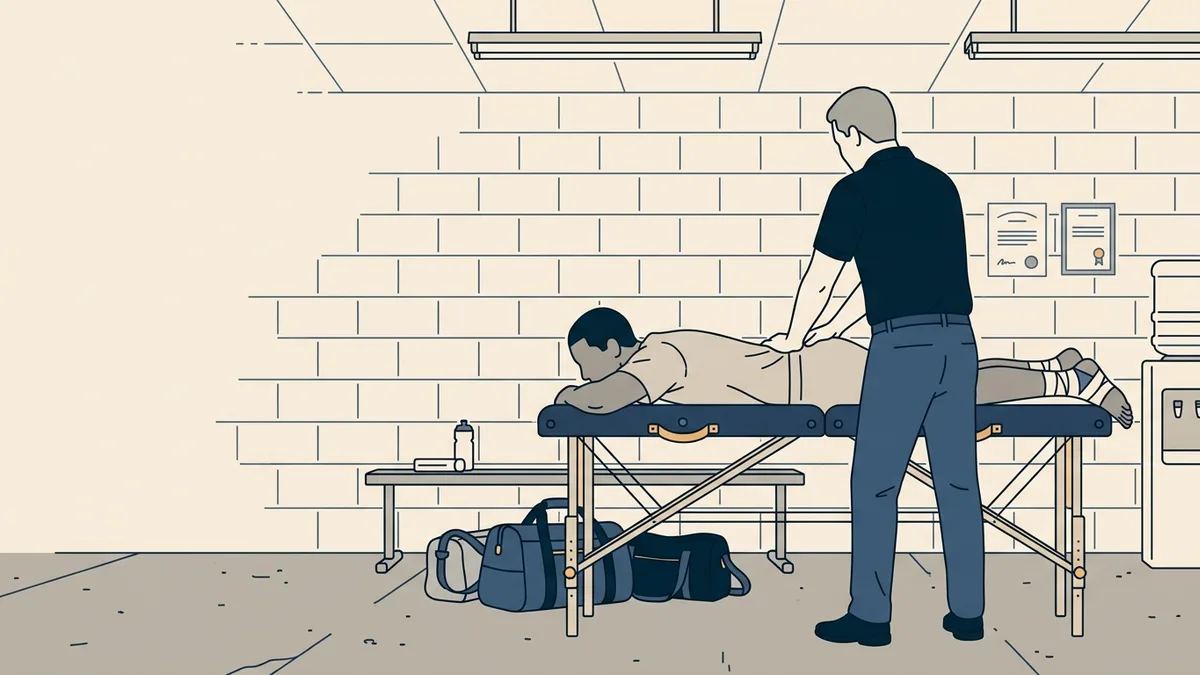
Some states let out-of-state chiropractors treat briefly: Texas caps a temporary license at 30 days a year, Georgia limits visitors to a sports or performing arts event, Oklahoma requires registration three weeks ahead, and Iowa issues discretionary temporary certificates. California issues no temporary permits. A 2018 federal law, 15 U.S.C. § 8601, covers some team care.
A chiropractor licensed in one state generally needs authority from the other state before treating anyone there, even for a weekend. A handful of states provide a short-term route for that: a temporary license, a travel-to-treat registration, or a visiting-practice rule tied to a sports or performing arts event. Others provide nothing at all; California's regulations say plainly that "the California law does not provide for the granting of temporary permits or licenses" (16 CCR § 320). A separate set of states offers a temporary or provisional license to people who have applied for a full license. The two are easy to confuse, and they solve different problems.
What are the two kinds of temporary authority?
- Event or visit permits let a chiropractor licensed elsewhere treat for a defined event or period without moving. They are built for team chiropractors, seminar instructors and disaster volunteers.
- Applicant bridge licenses let someone who has applied for a full license practice, often under supervision, while the application is decided. They are built for people relocating.
Using the wrong one is a common mistake. Texas, for example, says its temporary license does not apply to anyone residing in Texas, establishing residence there, or seeking a regular license.
Which states have event or visit permits?
Examples we have verified in the state's own rules or board pages:
- Texas (22 Tex. Admin. Code § 72.15). A temporary license for a chiropractor with an active, unrestricted license elsewhere and no pending discipline, for no more than 30 days in a calendar year. Apply at least 14 days before the work starts, with a description of where, when and for whom you will treat and the business, person or event you are with. Holders may not treat the general public.
- Georgia (Ga. Comp. R. & Regs. 100-13-.01). A chiropractor licensed in good standing anywhere, including another country, may practice when employed or designated by a visiting sports or performing arts entity for a specific event. Treatment is limited to the team or event's members, coaches and official staff, or to the individual athlete or performer who requested it, and to the designated venue or treatment area. Georgia's scope applies, and electrical therapeutic modalities require the 120 hours of instruction Georgia requires of its own licensees. A violation ends the privilege immediately and can count against a later Georgia application.
- Oklahoma (59 O.S. § 161.6(B)(18), per the Oklahoma Board of Chiropractic Examiners). Out-of-state chiropractors may treat at special events, including sporting events and state emergencies, after registering with the board. The board asks for applications at least three weeks before the event.
- Iowa (Iowa Admin. Code r. 645-41.5). A temporary certificate issued at the board's discretion for a demonstrated need: a special activity, event or program in Iowa, a declared state emergency, volunteer care by a former Iowa licensee, or another urgent need. It lasts one year, and the holder can convert to a permanent license by meeting the full requirements, with fee credit if done before the certificate expires.
Which states offer a bridge license to applicants?
- Pennsylvania (49 Pa. Code § 5.13b). Since July 25, 2026, a provisional endorsement license at the board's discretion while an endorsement applicant finishes the remaining requirements. Up to one year, one extension of up to a year for good cause, and only one per applicant.
- Washington (WAC 246-808-130). A one-time temporary practice permit for applicants, with verifications sent directly from every licensing state. It ends when the license issues, an investigation opens, the applicant fails the commission's exams, or after three months.
- Georgia (Ga. Comp. R. & Regs. 100-16-.01). A temporary license filed with the regular application, practiced only under the on-site supervision of a board-approved Georgia chiropractor.
- Utah (Utah Admin. Code R156-73-303). A temporary license of up to six months for an endorsement applicant, under the indirect supervision of a division-approved chiropractic physician who supervises no more than two people. It cannot be renewed or extended.
- Florida (Fla. Stat. § 460.406(4)). Not a permit, but an applicant who has met the requirements and passed the state exam and has the department's written notice may practice for up to 45 days, or until the licensing fee is received, while waiting for the license.
What does the federal law do for team chiropractors?
The Sports Medicine Licensure Clarity Act, enacted in 2018 and codified at 15 U.S.C. § 8601, covers a "covered sports medicine professional": a physician, athletic trainer or other health care professional licensed in their primary state who provides care under a written agreement with an athlete, team, national governing body, high school or college, and who has told their liability insurer about the arrangement in advance. For that professional, malpractice coverage follows them into the secondary state, and they are treated as meeting the secondary state's licensure requirements to the extent those are substantially similar to the primary state's.
The limits matter. The services must be within the scope of the primary-state license and may not exceed a similar license's scope in the secondary state. "Covered medical services" do not include care given at a health care facility, defined to exclude arenas, stadiums, practice facilities and temporary event facilities. The American Chiropractic Association reported in October 2018 that it worked to make sure chiropractors were included. Read § 8601 with your insurer before relying on it, and see licensing for chiropractors who travel with sports teams for the practical side.
Where does the FCLB Passport fit?
The Passport is a credential verification program from the Federation of Chiropractic Licensing Boards, designed to support boards that offer temporary licensure. It is not itself a license, and a board decides whether it uses the Passport in its process. We have not verified a list of states that accept it, so we check with the specific board for each event. More in the FCLB Passport, explained.
What happens if I treat without authority?
The patient's state treats it as practicing without a license. North Carolina, for example, makes practicing chiropractic without a license a Class 1 misdemeanor (N.C.G.S. § 90-147), and Texas's rule treats a licensee who fails to renew as practicing without a license and subject to discipline (22 Tex. Admin. Code § 72.14). Beyond the legal exposure, unlicensed practice becomes a history question on every later application: Georgia, for one, says a violation under its visiting-practice rule may be grounds to refuse or sanction a later Georgia license. One unpermitted weekend can cost far more than the permit would have.
How should I plan a short-term trip?
- Start with the patient's state. Find the board's rule, not a summary, and confirm whether it covers your situation: event, team, seminar or emergency.
- Count the lead time. Texas wants 14 days; Oklahoma asks for three weeks. Verifications from your home board can take longer than either.
- Check the scope limits. Georgia applies its own scope and its electrotherapy training rule to visitors; Texas bars treating the general public.
- Tell your insurer in writing. The federal law depends on it for team work, and most policies have their own notice terms.
- If you keep coming back, get the license. Repeated event permits are not a substitute; Texas, for one, caps its temporary license at 30 days a year.
Can White Glove handle event permits?
Yes, as part of a License by Endorsement engagement or the Readiness Review. For a team or a group practice that travels, we map each upcoming event to the patient state's rule, file the permits on the right lead time, and flag the states where a full license is the only option. Plans start with the $149 Chiropractic Licensure Readiness Review; full licenses are $499 per state by endorsement. Board fees are separate. The portability hub explains why there is no shortcut through a compact.
Common questions
- Can I treat athletes in another state with my home chiropractic license?
- Sometimes. 15 U.S.C. § 8601 treats a covered sports medicine professional with a written team agreement and insurer notice as meeting the other state's licensure requirements where they are substantially similar, but not for care at a health care facility. Some states, like Georgia, also have their own visiting-practice rules.
- Does California allow temporary chiropractic permits?
- No. 16 CCR § 320 states that California law does not provide for the granting of temporary permits or licenses.
- How long can I practice in Texas on a temporary chiropractic license?
- No more than 30 days in a calendar year under 22 Tex. Admin. Code § 72.15, applying at least 14 days ahead, and not for the general public.
- Is the FCLB Passport a temporary license?
- No. It is a credential verification program that some boards may use in their temporary licensure process. The board in the patient's state issues any permit.
Need Help with Your Application?
We handle the chiropractic licensing process end-to-end — eligibility screening, documents, board follow-ups, and tracking.